Showing posts with label books. Show all posts

Friday, October 29, 2010

Best Halloween Book: Haunted House!


This book highlights most of the six ready to read skills . Visally, the book is appealing because of the shiny orange colour on the cover. The cover is also covered in a fuzzy purple material, which makes it fun to touch. The story itself is written in rhyme and features many favourite Halloween spooks. In the end, children will be surprised by a shrieking witch! Don't worry though, it's not scary.

Find it at your local public library or check in out in a bookstore this weekend!

Monday, October 18, 2010

Growing Vegetable Soup


Fall is the time of year where we harvest food. Once the weather starts to cool down, it's natural to grab for a sweater and start up a pot of soup for warmth. Growing Vegetable Soup by Lois Ehlert presents the perfect opportunity to talk about the things that we naturally do at this time of year. Children benefit by learning from relevant events in their lives. Read this book with your child. There are SO MANY ways that you can extend this book into so much more than it is alone. You can develop vocabulary by talking about the names of vegetables, develop tastebuds by sampling different kinds of vegetables, develop narrative skills and numeracy skills by making a pot of soup, and so on.

More information on skills addressed in this book:

• Print motivation – at the end of the story there is a recipe for vegetable soup (shows children practical use of books – they show us how to do things)

• Print awareness – not all sentences finish on the same page they started on. This could start up conversations on how we know when a sentence is done (along with other aspects of punctuation) with older children.

• Vocabulary – vegetables, gardening tools and kitchen supplies are labeled throughout the book, including when they are seeds

• Narrative skills – tells children the process of making vegetable soup from seeds.

Here is an activity you can do with this book:


From the Garden to Soup

o Create vegetables using craft foam.

o Place vegetables in some dirt you may have left over from your garden. You can also use a blanket to simulate earth.

o Invite one child to be a “sounder” and another to be a “matcher”. Have the sounder secretly choose an item from the “dirt” and say the first sound of the item. For example, say “C-c-c” for carrot. Depending on your children’s ability level, you should be the sounder for the first few times that you model the game.

o Once the sound has been heard, the matcher finds an item in the “dirt” that starts with the same sound. If that item is not the item the sounder has chosen, you can help the matcher by giving clues. Continue until the matcher holds up the correct item. When the matcher selects the correct item, he can put it into a soup pot. Play again using another set of children as a sounder and a matcher.

o This activity can help younger children label things that grow in a garden. If you are working with younger children, you could ask them to find colours, “Can you please find me the white onion, orange carrot, red tomato…..

o You could also add some foam alphabet letters to the soup to work on letter recognition. Say, “Can anyone find me a letter “A” and or the letter that starts with the sound /a/ to add to our soup?”


What else would you do with this book?

Wednesday, October 13, 2010

The Grouchy Ladybug

This Eric Carle book is about an arrogant ladybug who challenges another ladybug to a fight over some aphids. Then, he decides his opponent isn't large enough to be worth fighting, so the ladybug travels around the world looking for larger animals to fight. Eventually, he encounters a blue whale, who slaps him with his tail and sends him flying back to where he started. The ladybug decides to be nice and share the aphids with the fellow ladybug.

Throughout the book, the size of the pages starts small and get bigger as the size of the animals increase. Also, the blue whale's tail takes up a page in itself and turning it is meant to represent the slapping motion. The time of day is also shown at the side of each page. Note: Many children will not be prepared to graps the complex concept of time until they are approximately 7-10 years old.


Here is a link if you would like to browse the inside of the book.

The ladybug above was made using black and red felt. First, I cut out a body, then, the wings, then the spots. The wings were secured on using hot glue. Here are two ways you can use the ladybug:

1) Phonemic Awareness: At age fix to six years children can identify different sounds at the beginnings of words (rock, sock), as well as different sounds at the ends of words (stem, step). Give each child a black dot. Say a word that begins or ends with a letter (e.g., the letter “g”). If they hear the /g/ in the beginning of the word, they put their dot on one half of the ladybug. If they hear the /g/ at the end of the word, they put the dot on the other half of the ladybug. When each child has had a turn, they can remove the dots and listen for a sound in another word.

2) Mathematics: Between age two and three years children know that when one candy is taken away from two candies, one candy is left. Similarly, they know that when one candy is added to two candies, there should be three candies altogether. Roll a number cube with your child and have them match the number of spot on ladybug to the number of spots on the cube. This will help them build a foundation for 1:1 correspondance of numbers.

Links

Let's Talk about the Grouchy Ladybug

Website full of resources and ideas to use with this book

Ideas for Using the Grouchy Ladybug in the Classroom

Friday, October 8, 2010

The Old Lady is Indulging Again...


I Know An Old Lady Who Swallowed a Pie by Alison Jackson is a cumulative book that mirrors the story I Know an Old Lady Who Swallowed a Fly. This book differs in that it is centred around the traditional Thanksgiving meal.

Remember to explain the rich vocabulary offered along with the rich foods in this story to your child.

Here is a video of a boy reading the story.

Here is a link to the words in the story so you can recite it without the book.

Enjoy the long weekend! Don't eat as much as the old lady!

Thursday, October 7, 2010

Terrific Turkey Book


10 Fat Turkeys by Tony Johnston isn't really a Thanksgiving book in itself, but I am featuring it this week because many families will sit down and enjoy a tasty turkey feast this weekend. This simple subtraction book counts down from 10 to 0 turkeys with funny rhyming text and playful illustrations.

Here is an example of a kit created to link math and literature which uses this book:


If you are looking for some additional activities to accompany this book, try these:

Do the turkey pokey - Sing the Hokey Pokey like normal, but then the last line goes as follows: "You do the Turkey Pokey and you gobble all around, that's what it's all about."

Handprint Turkey with Poem

Interesting Turkey Facts

Turkey Cut-Out Pattern - can be used with some of the rhymes below or to help retell the story. I would resize them to 1/2 the size of the paper.

Songs and Rhymes

NINE LITTLE TURKEYS (A Counting Rhyme)
One little, two little, three little turkeys
Four little, five little, six little turkeys
Seven little, eight little, nine little turkeys
Out in the barnyard.

Gobble, gobble, little turkeys
Gobble, gobble, little turkeys,
Gobble, gobble, little turkeys.
Out in the barnyard.
by Jean Warren

TURKEY, TURKEY (A Number & Color Rhyme)
Turkey, turkey number one
Strutting under the yellow sun.

Turkey, turkey number two
Strutting under skies of blue.

Turkey, turkey number three
Strutting under a big green tree.

Turkey, turkey number four
Strutting past the red barn door.
by Jean Warren

MR. TURKEY
Mr. Turkey's tail is big and wide. (spread hands)
He swings it when he walks. (swing hands)
His neck is long, his chin is red. (point)
He gobbles when he talks. (open and close hand like a mouth)

Wednesday, October 6, 2010

Grateful for great books!


Lately, I spent some time reviewing my collection of Thanksgiving books. Thanksgiving is one of my favourite holidays. Here's why:

- families get together
- there is no gift giving expectation
- fantastic fall weather
- delicious food

The book Thanks for Thanksgiving by Heather Patterson really captures the beauty of Thanksgiving, which is really just being mindful of all simple things that bring us pleasure at this wonderful time of year.

Here is an excerpt from the book:

Thanks for the warm fall sun.

Thanks for the outdoor fun.

Thanks for the blue fall sky

and the sound of the birds' good-bye.

Thanks for the golden trees.

Thanks for the crunch of leaves.


Borrow it from your local public library and share it with your child today :)

Does anyone have any other great suggestions for Thanksgiving books?

Monday, September 27, 2010

Are you Leafing Around for a Great Fall Book???


If you find yourself leafing around for a great fall book, look no further than one of the beautiful books above all about LEAVES!

When the Leaf Blew In by Steve Metzger

Red Leaf, Yellow Leaf by Lois Ehlert

Leaf Season by Quintan B. Lee

The Leaves are Falling One by One by Steve Metzger

Leaves! Leaves! Leaves! by Nancy Elizabeth Wallace

Leaves, Leaves, Leaves by Melvin and Gilda Berger

Of course, there are likely many other great leaf books out there. I have merely listed are ones that I own. When looking for books consider a few things: do you want fiction or non-fiction? Children may not understand that books are about the world we live in because they get used to seeing illustrations instead of pictures. Does the book have a great rhyme? Does it have rich vocabulary? Does your child enjoy it?

Please share the names of any other great fall books. I will have more fall book lists as the weeks pass.

Friday, September 3, 2010

Magazines for Children

I found myself in Chapters this past weekend looking for a good book for one of my favourite youngsters. Instead of immediately making my way back to the children's section, I decided to change it up and see what is available for children in the magazine aisle. I remember getting Highlights in the mail as a child. I enjoyed this monthly treat for two reasons:

(1) I got MY very own magazine in the mail (so cool in grade 2); and

(2) Who doesn't love getting mail (as long as it's not a bill, but what eight year old gets bills?)

Anyway, after carefully flipping through all the magazines and evaluating them for their age-appropriateness, interestingness, and general appeal I chose this:


National Geographic Little Kids is for children 3-6. I was really impressed by the issue I picked up. It had great activities that children can sit and look at with adults, as well as amazing pictures of animals with brief sentences to describe the pictures.


For those of you with young boys (and girls, too!), I would advise checking this out.

Has anyone seen good children's magazines they would like to mention?

Wednesday, August 25, 2010

SEEing print

Children also need to see lots of words in print and to watch other people write. You can provide such experience for your children by:

- helping them write their names on their pictures and belongings - "Sandy, you make an 'S' and I'll make the rest of your name"
- reading books to them
- writing messages to them - "Today is your birthday!"
- writing down what your children tell you about their drawings (you can help them make books by writing down a story to go with the pictures they have drawn)
- pointing out letters and words on street signs, food containers, store fronts, etc. - "Let's look for signs that begin with 'S'"
- letting them watch you write letters or shopping lists \

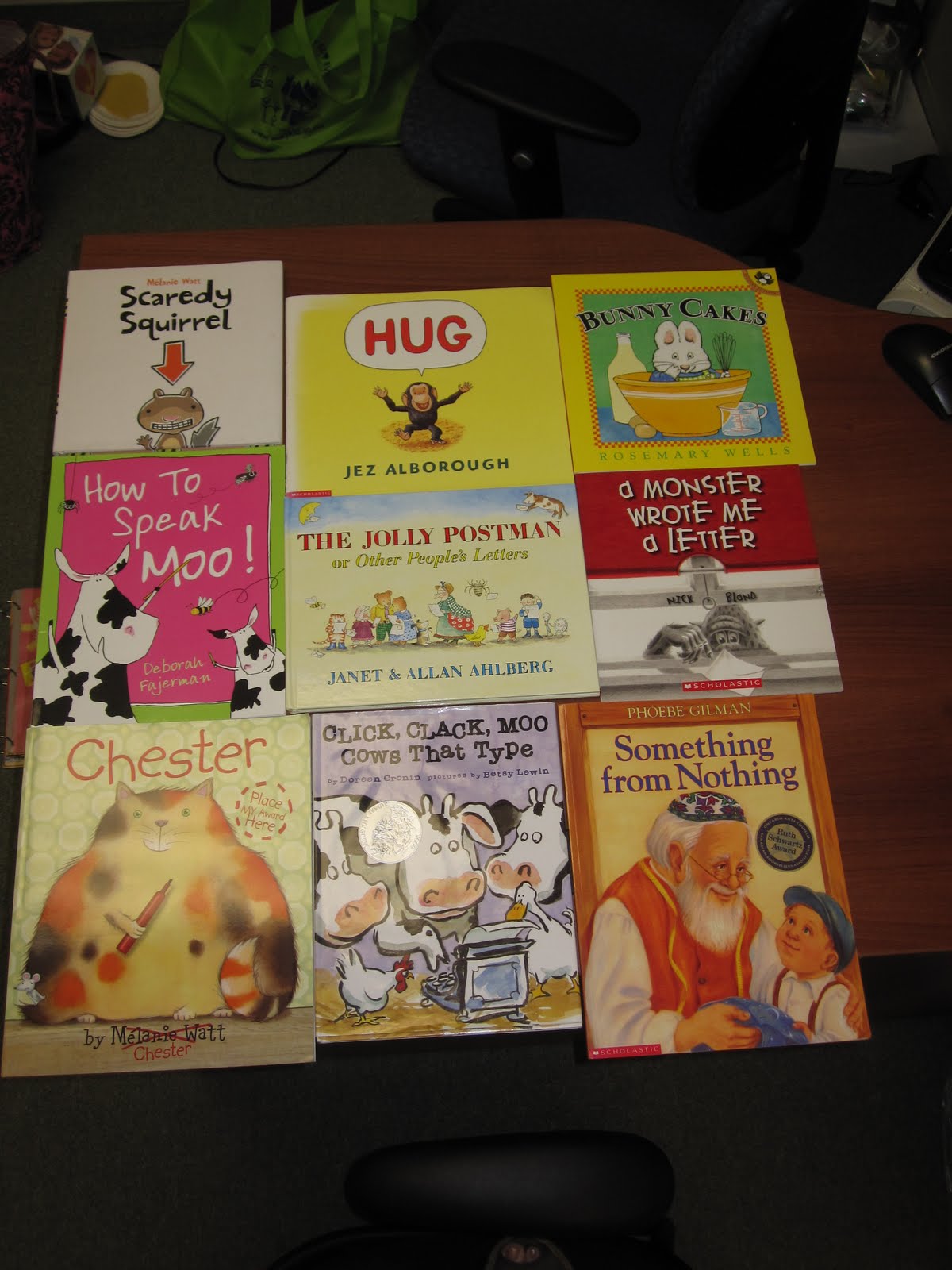
Below are some books where children can see print (aside from the text in the story).


Bunny Cakes by Rosemary Wells


Chester by Melanie Watt


CLick, Clack, Moo: Cows that Type by Doreen Cronin


More book ideas will follow this week, but be sure to suggest a title if you know of one.

Thursday, August 19, 2010

It's the Most Wonderful Time of the Year...


The nights are getting shorter, the malls are packed, and teachers and children everywhere are wondering how it is possoble that the summer is almost over. Soon, it will be time for children to go back to school for another year of learning. You can help prepare your child for the transition by reading "school" books with them.

Will this be your child's first time to school? If so, please see kindergarten books.

Above is a picture of some school books from my personal collection.

If You Take a Mouse to School by Laura Numeroff
A Monster Followed Me to School by Mercer Mayer
Miss Nelson is Missing by Harry Allard
I Want to be a Teacher by Michaela Muntean
Welcome Back to Pokeweed Public School by John Bianchi
Miss Nelson is Back by Harry Allard
My School's a Zoo by Stu Smith
The Berenstain Bears and the Substitute Teacher by Stan and Jan Berenstain
Teach Us, Amelia Bedelia by Peggy Parish
David Goes to School by David Shannon


What book(s) do you read to get your child ready for school?

Thursday, August 5, 2010

Choosing Home Library Books


Yesterday I wrote about creating home libraries on a budget. At the end of the posting I suggested that it is important to choose quality books over quantity. Perhaps you're wondering what type of books to look for in a balanced home library? Well, here are some suggestions:

- alphabet books
- number books
- fiction
- non-fiction
- poetry
- nursery rhymes
- books you can sing
- fairy tales
- wordless picture books
- predictable books
- science books

Are there any other suggestions?

Wednesday, August 4, 2010

Pinch pennies and build a home library


With all the new toys and gadgets for kids, books are in tough competition for your child's time. However, books are perhaps THE most important toys you will ever give your child. Starting a home library for your child shows him/her how important books are. Having books of his/her own in a special place boosts the chance that your child will want to read even more. Here's the trouble: having a good collection of children's books can be costly. At $10-$20 per book, with a collection of 30 books (at least!) you're looking at spending $300-$600!!! That adds up quickly. Here are some ideas for creating your own inexpensive home library.

- Borrow books from your local library on a regular basis. In addition, find out what services your local library provides such as children's story time, workshops, and so on. Who didn't enjoy going to the library to listen to stories as a child?

- Teach children to handle books appropriately so books last for years and years (and so books can be responsibly borrowed from the library). When you do buy books, their initial cost will seem a whole lot less if you can use them for a long time rather than having to replace scribbled-in, beat up, or worn books.

- Organize a children's book swap with friends, community groups, or your day care.

- If you're a child care provider, start a tradition. Tell parents that you think that reading to children each day (and having lots of interesting books available for children) is important. Ask parents to bring in one book "each Monday" or "the first day of the month." Make good use of these extra books (for the day, for a week, or whatever you and parents decide).

- If you're a child care provider, start another tradition. Ask parents to donate books their children have "outgrown" to your program. Their children may no longer be reading certain simple books but children in your care now (or at some time in the future) will enjoy them.

- If you're a parent, start a family tradition. Ask friends and relatives to consider giving your children books as gifts for their birthdays and on holidays.

- The price of children's paperbacks is low compared to the retail cost of hard-cover versions of the same book. Buy paperbacks when you can.

- Buy children's books on sale at book fairs (Scholastic).

- Buy some children's books at library sales. Call the library in your county and libraries in surrounding counties to see if they hold annual library fund-raising sales of books. If so, you can support a good cause and pick up some real bargains.

- Buy some books at second-hand bookstores and local yard sales.

One last thing

Remember, it's not quantity, but quality books you are looking for in your library.

Please suggest the name of a quality children's book in the comments.

Watch this video review on the book Tip Tip Dig Dig by Emma Garcia.

Tuesday, July 6, 2010

Shape Monster Booklet


Help your child notice shapes by pointing them out and talking about them. Seeing and recognizing shapes is a very important step children must take before learning their letters of the alphabet. When you think of an upper case A, there is a triangle shape in it.

Go to the website below to find a printable Shape Monster booklet. Your child can colour the shapes in it. Afterwards, you can read it together!

Click here for the Shape Monster Booklet!

Another Idea...


Look at the book Colour Zoo by Lois Ehlert. It is really fascinating how you can see the animals just using basic shapes. Ask your child, "What animals do you see?"

Read the book. Talk about the shapes as well as the animals. The back of the book has separate shapes which you can also point out or refer to from time to time as you read the book.

Monday, July 5, 2010

It's Berry Season!!!


Berry picking with young children is a great way to spend a summer day. Try to expose your child to many new events to help them understand the world around them. Many children love to eat berries as a snack, so it's a great idea to take them to the berry patch where they can see how berries are grown. You'll be amazed at the new vocabulary your child will be learning! Remember to talk with your children as they are picking so they have a chance to learn new words. Ask them questions and encourage them to explore. Isn't that what being a child is all about?

Here are some tips for taking children berry picking:

1. Take a bottle of water for each person. Hard working pickers get thirsty!

2. Expect them to eat as they pick!

3. Take pictures of your kids when you first arrive. Be sure you squat down to your child's level to get the best pictures. You could use these pictures to write a home made book with your child on a rainy day.

4. Wear hats and sunscreen. The sun can be brutal in an open field.

5. EVERYONE should wear red shirts. Little hands WILL get wiped on their shirts and yours, too! And strawberry juice STAINS!

Once you arrive home and have had a chance to enjoy some of your berries, curl up and read a book together.

Here are some suggested titles:

Blueberries for Sal by Robert McCloskey


The Little Mouse, the Red Ripe Strawberry, and the Big Hungry Bear by Don and Audrey Wood


Here is a YouTube link to someone telling the story!

Wednesday, June 2, 2010

Reading is as easy as ABC

One of the best predictors of early reading success is alphabet recognition. Alphabet books are a great way to talk about letters with your child. Many alphabet books centre on child-friendly themes or concepts, such as animals or places.

Alphabet books are a fun way to help your child:
Learn the letter sequence of the alphabet
Connect the printed letters with letter sounds
Develop vocabulary and stimulate language use

The first time you read an alphabet book with your child, read it without pausing so they can enjoy the language and illustrations. Next time you read it, talk about the names of the letters and the sounds the letters make.

Focus on sounds that are important to your child. For example, if your child’s name is Melissa, talk about how the letter M makes the sound ‘Mmm’ like “Mmm...muffins!”